The Art of History in Framingham: Medium & Memory
Our community remembers history through stories, text, objects, and art. The Art of History in Framingham explores how art can preserve, interpret, and shape our understanding of the city’s past, bringing historical works from the collection and contemporary artists into conversation with the people, places, and stories of Framingham.
For months, I spent a lot of time in the collection at the Framingham History Center. With more than 20,000 artifacts in its collection storage, we had a lot to consider. Our docent, Barbara Rosenberg, did much of the work of going through the collection and selecting objects for us to consider. From there, we organized the selections into eight mediums: photography, painting, performing arts, literary arts, sculpture, accessories, textiles, and music.
Once the objects were chosen, we reached out to local artists and invited them to create new work inspired by something from the collection. The medium did not have to match the original object. We wanted artists to have the freedom to respond to Framingham history in their own way.
Among the artists we collaborated with were Kendall Winston, a textile artist and recent Framingham State University graduate, who created a striking framed floral textile piece inspired by a painting by Margaret Kendall; Pam Bonaguide, whose sculpture was inspired by an old photograph of a play at the Reformatory Prison for Women, now MCI-Framingham. Her work makes us think about the children of incarcerated women peeking through the curtains to watch their mothers perform; Larisa Gotovkina, a local mixed-media artist who responded to a beautiful 1920s poster of “Margie and her maids” by incorporating a violin into her work; and writer Bracken MacLeod, who responded to a photograph by Wallace Nutting by creating an original short story inspired by the image.
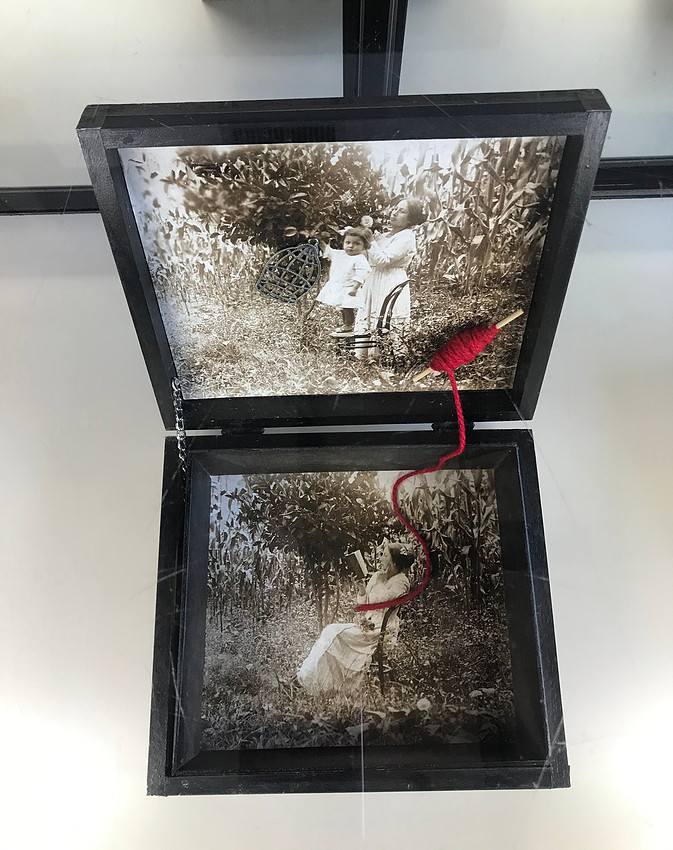
Then there is my own work, Historia de una Madre (“A Mother’s Story”). It features two photographs of my great-grandmother: one with her daughter, my grandmother, and another of her sitting in a chair reading a book.
While researching and working on the piece, I discovered that my grandmother had been adopted. What I had always understood about my family history suddenly changed. The connection I thought I had to my great-grandmother was more complicated than I had realized, and there was now a missing part of my family story that I could not fully explain.
In one of the photographs, I gave my grandmother a birdcage. She grew up knowing she was adopted and feeling different because of it. She married young and eventually left home. The birdcage represents both her longing for freedom and the unanswered questions about her biological parents.
To process this discovery, I added a strand of red yarn to the piece. Yarn has been a recurring element in my work. It connects me to my roots and to the women in my family, who passed down skills like sewing, embroidery, and working with their hands. The red represents blood, family ties, and the connections that bind generations together. It also represents the gaps in my own family history. For me, art creates a space to explore these connections, to make sense of what has been lost, and to sit with the things we may never know.
I built the work inside a cigar box that opens and closes. This echoes the historic brooch displayed next to it in the gallery, which contains human hair. Before photography, keeping a lock of a loved one’s hair in jewelry was one way people held onto their memory. Today, we use photographs. Placing Historia de una Madre next to the hair brooch creates a connection between these two ways of remembering and the very human need to hold onto the people we love.
The exhibition opened at the Framingham History Center, Edgell Memorial Library, on August 27, 2026.